
The Value of Mental Flexibility, and How to Help Your Kids Build It
My 4-year-old daughter had a plan. Pancakes for breakfast, the blue cup, her favorite show before school. Then: The milk was gone, the blue cup was in the dishwasher, and the show got preempted for the news. What follows isn’t really about pancakes or cups. It’s a full system meltdown over a morning that didn’t go the way her brain had already decided it would. UGH!!!
You’ve probably lived some version of this. And, if like me, you’ve ever wondered why a small deviation from plan can produce a disproportionately large reaction, most of the time the answer has less to do with willfulness and more to do with a skill still under construction: mental flexibility.
What Is Mental Flexibility?
Mental flexibility is the ability to shift thinking, adjust expectations, and consider more than one way of seeing a situation. It’s what lets a person move from “this isn’t how it’s supposed to go” to “okay, here’s another way we could do this.” It’s a core piece of executive function, which means it’s housed in the prefrontal cortex, the part of the brain that is the last to fully develop, often not until the mid-twenties.
That single fact reframes a lot of parenting moments. Like my daughter at 4-years old, a child who rigidly insists on one version of how something must happen, isn’t necessarily being stubborn for their own sake. Their brain hasn’t yet built the architecture to easily generate and hold alternatives. Rigidity, at least some of the time, is developmental, and this developmental structure is slow to build and refine itself. That 4-year old stuck on the blue cup is now 15, and still struggles with aspects of executive functioning and situational control at times. This is not a character flaw to correct, but a skill still building.
Understanding the slow and intentional development of this skill matters because flexible thinkers tend to fare better across a lifetime. They handle disappointment with more resilience. They navigate friendships and group dynamics with more ease, because relationships constantly demand adjusting to other people’s perspectives and plans. They problem-solve more creatively, because they can hold multiple possible solutions instead of fixating on the first one. And they tend to experience less anxiety, because so much anxiety is fueled by a rigid insistence that things must go exactly one way.
Where Parents Get in Their Own Way
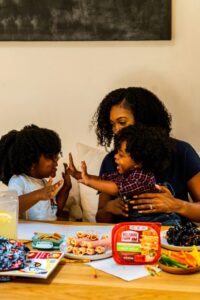 Here’s the tension: it’s often easier, in the moment, to just accommodate the rigidity than to help a child move through it. Swap the cup. Skip the show. Smooth it over. This tension becomes even greater as little kids become big kids with bigger demands, louder voices, and firmer autonomy. Sometimes smoothing it over is the right call. Not every moment is a teaching moment, and children need real flexibility from the adults around them, too. But when accommodation becomes the default response to every instance of rigid thinking, kids lose the repeated, low-stakes practice they need to build the skills along the way, themselves.
The other trap runs the opposite direction: Treating the meltdown itself as the problem to be shut down, rather than a signal that flexibility is being asked of a brain that isn’t yet equipped to deliver it easily. “You’re fine, it’s just a cup” or “chill out, you don’t get everything you want” might be true, but it doesn’t support anything. It just tells a child their internal experience was an overreaction, which tends to produce more shutdown, not more flexibility.
Building the Skill, Not Just Managing the Moment
 The good news is that mental flexibility is trainable, and the best training doesn’t require a curriculum. It happens in the small frictions of ordinary days and how we, as parents, model it. Kids learn best through observance, practice, failure, and thoughtful re-approach.
Narrate your own flexibility out loud. Kids absorb far more from watching how you handle a disrupted plan than from anything you tell them about it. “I was planning to make dinner, but we’re out of ingredients. Let me think of what else could work” is a small moment, said aloud, that models the exact mental move you want your child to eventually make on their own.
Offer real choices, not just directives. Choices are a low-stakes flexibility gym and work best what started young. “Do you want to read two short books tonight or one long one?” asks a child to weigh options rather than simply comply or resist. Over time, the muscle of weighing options generalizes beyond the specific choice in front of them, leading to an easier time weighing the options of “Do I want to play soccer or join the play?” or “Do I want to get my homework done right away or take a break first?”
Use games that require shifting rules or perspective. Simple games where the rules change partway through, or that require taking another player’s point of view, are doing real cognitive work disguised as fun. Even ordinary pretend play, where a child has to hold their own perspective and their character’s perspective at once, is flexibility practice.
Validate before you problem-solve. When a plan falls apart and the reaction is big, the instinct is to jump straight to the fix. “It’s okay, we can watch the movie later.” But flexibility can’t be taught to a nervous system that’s still flooded. Naming the feeling first creates enough calm for the thinking brain to come back online. “You really wanted that show. This is so disappointing.” Only when settled is a child actually available to consider alternatives.
Ask, “What’s another way?” as a regular question. When something doesn’t go as planned, resist solving it immediately. Instead, ask your child what else might work. Even if their first answer is a shrug or “I don’t know,” the question itself is the training. It signals that alternatives exist and that finding them is their job to practice, not just yours to hand over.
Mental flexibility isn’t something kids either have or don’t. It’s built the same way most durable skills are built: through repetition, low-stakes practice, and adults who model the very thing they’re hoping to teach. The blue cup will still be in the dishwasher tomorrow. But each time your child finds their way to “okay, I can use the other one,” they’re not just solving a small problem. They’re strengthening a capacity that will serve them in every relationship, setback, and unexpected turn still ahead of them.
If you liked this article, check out these: